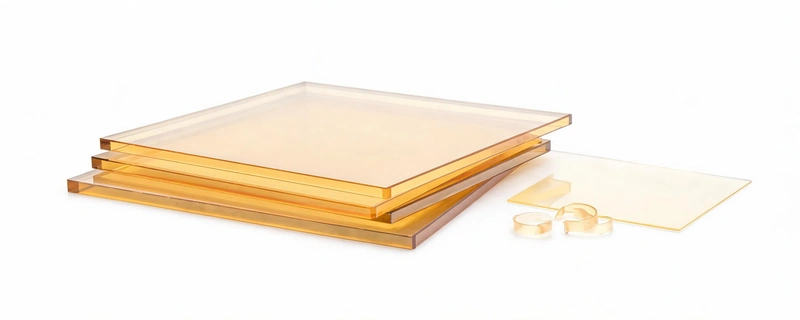
PSU (Polysulfone) sheet is a high-performance amorphous engineering thermoplastic known for its natural amber transparency, dimensional stability and resistance to hot water and steam in suitable operating conditions. It is used in selected medical equipment, fluid-handling systems, food-processing equipment and electrical components.
1. What Is PSU Sheet?
PSU sheet is manufactured from polysulfone resin, a member of the sulfone family of high-performance thermoplastics. Standard unfilled grades are often transparent with a light amber or brownish tint. This appearance can be useful when a component needs visual inspection of internal fluid flow or operating conditions.
PSU is an amorphous polymer. Unlike semi-crystalline materials, it does not have a crystalline melting point in the conventional sense. Its glass transition temperature is typically around 185°C for many standard grades. This thermal characteristic contributes to its performance in applications involving elevated temperatures, although the allowable service temperature depends on the grade and operating conditions.
PSU offers a useful combination of toughness, stiffness, electrical insulation and hot-water resistance. It is not a universal replacement for every high-temperature plastic: chemical exposure, mechanical loading and long-term temperature must all be considered during material selection.
2. Key Properties of PSU Sheet
Transparency and Visual Inspection
Natural PSU grades can provide transparent or translucent amber stock. This makes them useful for selected housings, inspection windows and fluid-handling components. Actual optical clarity depends on sheet thickness, resin grade, surface finish and processing history.
Heat Resistance
PSU retains useful mechanical properties at elevated temperatures. Its typical glass transition temperature is approximately 185°C, but this should not be interpreted as a recommended continuous operating temperature. Under load, long-term performance may be limited by creep, deformation and environmental exposure.
Hot-Water and Steam Resistance
PSU is known for useful resistance to hot water and steam in appropriately selected grades. It can be considered for certain fluid systems and equipment exposed to cleaning or sterilization cycles. Repeated exposure should be assessed against the actual temperature, pressure, cycle duration and component stress.
Dimensional Stability
PSU provides good dimensional stability for many precision components. However, machining stresses, uneven material removal, clamping forces and temperature changes can still affect final dimensions. Proper machining and inspection procedures remain important.
Electrical Insulation
PSU is used in selected electrical and electronic components because of its insulating characteristics and thermal performance. Electrical properties vary by grade, thickness, temperature, humidity and test method. Confirm the relevant data before specifying it for an insulation-critical design.
3. Typical Applications of PSU Sheet
Medical and Laboratory Equipment
PSU may be used for selected equipment housings, instrument components, fluid-handling manifolds and transparent parts where hot-water resistance and visibility are useful. Medical suitability is grade-specific. A standard industrial PSU sheet should not automatically be treated as a medical-grade or sterilization-approved material.
Food-Processing Equipment
Selected PSU grades can be considered for equipment components exposed to hot water, cleaning procedures or process fluids. Food-contact compliance must be verified for the exact resin grade and finished component, taking account of the relevant market regulations and operating conditions.
Fluid Handling and Inspection Components
PSU's natural amber transparency can support visual inspection in certain housings, covers and fluid-system components. Chemical compatibility must be checked carefully, especially where cleaning agents, solvents or stressed components are involved.
Electrical and Electronic Components
PSU sheet can be machined into selected electrical insulation parts, equipment supports and protective components. The appropriate grade should be selected according to dielectric requirements, temperature, mechanical loading and environmental exposure.
4. When PSU May Not Be the Right Choice
Although PSU offers a useful balance of properties, it has limitations that should be considered before specifying it.
- Strong UV exposure: Long-term outdoor exposure may cause discoloration and property changes. UV-stabilized grades or a different material may be more appropriate for demanding outdoor service.
- Solvent exposure: Some organic solvents, including certain ketones and other aggressive chemicals, can cause swelling, crazing or stress cracking. Check compatibility under actual conditions.
- High mechanical loads at elevated temperatures: Creep and deformation may become design concerns. Consider the applied stress and long-term temperature rather than relying only on the glass transition temperature.
- Applications requiring higher temperature capability: Depending on the design, PES, PPSU, PEI or PEEK may be worth evaluating.
Material selection should be based on the complete operating environment, not on a single headline property.
5. PSU Sheet CNC Machining Considerations
PSU sheet can be CNC machined into custom housings, covers, brackets, manifolds and other precision components. Good results depend on tool condition, machining sequence, stock quality and control of internal stress.
Use Sharp Cutting Tools
Sharp tools help reduce cutting forces, friction and localized heating. Dull tools can generate excessive heat and contribute to poor surface quality, burr formation or stress-related damage. Tool geometry and cutting parameters should be selected for the specific PSU grade and component design.
Control Heat During Machining
Excessive localized heat can affect surface finish and dimensional stability. Use suitable cutting conditions, avoid unnecessary tool rubbing and ensure chips can evacuate effectively. Coolant selection should be based on material compatibility and the machining process rather than assuming every coolant is suitable.
Minimize Clamping Stress
Use stable, evenly distributed workholding. Excessive clamping force can introduce stress into the sheet or distort thin components. Support delicate sections and avoid concentrated pressure points.
Plan the Machining Sequence
For larger or more complex parts, staged material removal may help reduce uneven stress release. Where dimensional requirements are demanding, allow the component to stabilize before final inspection. Any annealing or stress-relief procedure should follow the material supplier's recommendations for the exact grade and stock history.
6. PSU vs. PES vs. PPSU
PSU, PES and PPSU are all amorphous sulfone-family engineering thermoplastics. They share some characteristics but are not interchangeable in every application.
- PSU: Often selected for its balance of transparency, heat resistance, dimensional stability and hot-water performance.
- PES: Has a higher typical glass transition temperature than PSU and may be considered where greater thermal capability is required.
- PPSU: Often selected for demanding hot-water and repeated-use applications where toughness and impact performance are important.
Typical glass transition temperatures are approximately 185°C for PSU, 225°C for PES and 220°C for PPSU. These are representative values, not guaranteed specifications for every grade. Always compare the technical data sheets of the actual materials under consideration.
7. How to Choose the Right PSU Sheet
Before ordering PSU sheet, consider the following points:
- Thickness: Match the stock thickness to component dimensions, load, stiffness and machining allowance.
- Grade: Confirm whether standard, modified or application-specific PSU is required.
- Appearance: Specify the required transparency, color and surface condition if visual inspection is important.
- Operating environment: Provide temperature, pressure, fluid contact and cleaning or sterilization conditions.
- Compliance: Request the relevant documentation if the application involves food contact, medical equipment or regulated electrical systems.
- Machining requirements: Share drawings, tolerances and surface-finish expectations for custom parts.
Providing these details helps the supplier recommend a suitable stock grade and reduce the risk of selecting material based on incomplete specifications.
8. PSU Sheet Supply from Teda Plastics
Teda Plastics supplies engineering plastic materials in different forms for industrial buyers, distributors and machining companies. PSU sheet can be considered for projects requiring transparent or translucent stock, thermal performance and resistance to hot water in suitable environments.
When requesting a quotation, please provide the required thickness, width, length, quantity and application. If you need machined components, you can also send your drawings for review.
Frequently Asked Questions About PSU Sheet
1. What is PSU sheet?
PSU sheet is a high-performance amorphous engineering thermoplastic made from polysulfone. Standard unfilled grades are often transparent with an amber tint. The material offers a combination of heat resistance, toughness, dimensional stability and useful hot-water resistance in suitable applications.
2. What is the maximum operating temperature of PSU sheet?
Many standard PSU grades have a glass transition temperature of approximately 185°C. This is not the same as a recommended continuous service temperature. Practical operating limits depend on grade, mechanical load, exposure time, environment and component design. Consult the selected grade's technical data sheet.
3. Is PSU sheet suitable for repeated steam sterilization?
Selected PSU grades can perform well in hot water and steam environments. However, repeated autoclaving suitability depends on temperature, pressure, cycle duration, number of cycles, component geometry and residual stress. Validate the exact grade and finished part under actual service conditions.
4. Is PSU sheet transparent?
Many natural, unfilled PSU grades are transparent with a light amber or brownish tint. Clarity and color vary with grade, thickness, additives and processing history. Filled or modified PSU materials may have a different appearance.
5. Can PSU sheet be CNC machined?
Yes. PSU sheet can be machined into custom components using appropriate cutting tools and machining conditions. Sharp tools, stable clamping, heat management and a suitable machining sequence help achieve better surface quality and dimensional consistency.
6. Is PSU sheet suitable for food-contact and medical applications?
Selected PSU grades are used in food-processing and medical equipment applications. However, not every PSU grade is approved for food contact or medical use. Confirm the exact grade documentation and validate the finished component against the regulations and operating conditions in the target market.
7. What is the difference between PSU, PES and PPSU?
All three are amorphous sulfone-family thermoplastics. PSU is often selected for a balance of transparency, heat resistance and dimensional stability. PES has a higher typical glass transition temperature, while PPSU is frequently considered for demanding hot-water and impact-related applications. The best choice depends on the complete service environment.
8. How can I choose the correct PSU sheet thickness?
Consider component size, mechanical loads, stiffness, deflection limits, operating temperature and machining allowance. For custom parts, provide a technical drawing or application details so the required stock thickness can be evaluated before machining.
Looking for PSU Sheet or Custom Machined Parts?
Contact Teda Plastics with your required dimensions, quantity and application details. Our team can help you review material options and quotation requirements.
Request a PSU Sheet Quote