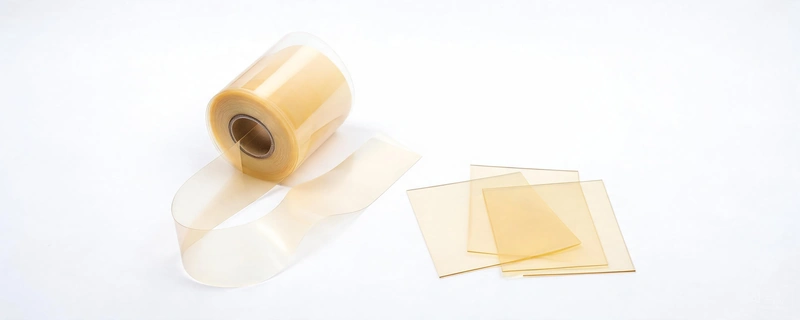
PSU film is a specialized thin-film form of polysulfone, an amorphous high-performance thermoplastic. Depending on its formulation and manufacturing process, PSU film can combine transparency, heat resistance, dimensional stability and electrical insulating properties. It may be considered for selected industrial, electrical and technical applications where ordinary commodity films do not meet the required performance.
What Is PSU Film?
PSU stands for polysulfone, an amorphous thermoplastic in the sulfone polymer family. It is known for its combination of heat resistance, stiffness, dimensional stability and useful resistance to hot water in suitable grades.
Natural PSU typically has a transparent amber or brownish appearance. When produced as a thin film, its optical appearance depends on resin grade, film thickness, surface finish, additives and processing conditions.
PSU has a typical glass transition temperature of approximately 185°C. This is a material transition reference, not a guaranteed continuous-use temperature for every film. The actual service limit depends on the film construction, mechanical stress and operating environment.
Key Properties of PSU Film
- Transparency: Natural PSU can provide an amber transparent appearance, which may be useful in designs requiring visual access or inspection.
- Thermal performance: PSU offers better heat resistance than many commodity thermoplastics, although actual film service limits are grade- and application-dependent.
- Dimensional stability: Its amorphous structure can help maintain dimensional consistency under appropriately controlled conditions.
- Electrical insulation: PSU can provide useful insulating properties for selected electrical and electronic components.
- Mechanical strength: PSU offers a useful balance of stiffness and toughness, subject to film thickness and processing quality.
- Hot-water resistance: Selected grades can perform in hot-water environments, but chemical exposure and sterilization conditions require validation.
How Is PSU Film Manufactured?
PSU film can be produced through specialized film-forming processes, including extrusion-based methods. The selected resin must be suitable for the intended process, and manufacturing conditions need to be controlled to achieve consistent thickness, surface quality and dimensional properties.
Important production considerations include resin drying, melt stability, filtration, die design, cooling conditions, film thickness control and surface handling. These factors influence the appearance and performance of the finished film.
Important Film Quality Factors
- Thickness tolerance: Consistent thickness is important for converting, assembly and electrical design.
- Surface quality: Scratches, inclusions and surface defects can affect optical performance and downstream processing.
- Transparency and color: Confirm the acceptable color, haze and light-transmission requirements for the application.
- Dimensional stability: Evaluate shrinkage, thermal expansion and dimensional change during processing and use.
- Electrical properties: Request relevant dielectric data when the film is intended for insulation or electronic components.
Potential Applications of PSU Film
PSU film may be evaluated for specialized applications that require a combination of thermal performance, transparency and electrical insulation. Its suitability depends on the exact film grade and the design requirements.
- Electrical insulation: Selected insulating layers, separators or protective components where the film's dielectric and thermal properties meet the design requirements.
- Electronic components: Specialized insulating or protective film constructions in electronic assemblies.
- Transparent technical covers: Thin protective layers or inspection windows where transparency and dimensional stability are useful.
- Medical equipment components: Selected transparent components or packaging-related constructions, subject to material documentation and finished-product validation.
- Industrial applications: Protective films and formed components used in controlled high-temperature or demanding environments.
Applications such as capacitor dielectrics, flexible printed circuits and medical sterilization packaging should not be treated as standard uses for every PSU film. These applications require specific electrical, thermal, chemical, sealing and regulatory validation. Other established film materials may be more suitable depending on the design.
PSU Film for Electrical Insulation
PSU has useful electrical insulating characteristics, making it a candidate for selected electrical applications. However, the suitability of a film for a particular insulation design cannot be determined from the polymer name alone.
Engineers should review dielectric strength, dielectric constant, dissipation factor, insulation resistance and performance after exposure to heat or humidity. Film thickness, edge quality, surface condition and manufacturing consistency can also influence the reliability of the finished component.
For capacitor or high-frequency applications, electrical performance should be tested under the actual voltage, frequency, temperature and operating conditions. A PSU film should not be specified as a capacitor dielectric without confirming that it meets the relevant design requirements.
PSU Film for Medical and Sterilization-Related Applications
PSU is used in selected applications involving hot water and demanding cleaning conditions. However, this does not mean every PSU film is suitable for medical packaging or repeated steam sterilization.
For medical-related applications, buyers should confirm the resin grade, film manufacturing controls, chemical compatibility, sterilization method and relevant regulatory documentation. The complete package or finished component must be evaluated, including sealing performance, mechanical integrity and any required barrier properties.
Gamma radiation, steam sterilization and other sterilization methods can affect polymers differently. Compatibility should be demonstrated for the specific film construction and intended sterilization cycle.
Can PSU Film Be Thermoformed?
Some PSU film grades and thicknesses may be suitable for thermoforming or other forming operations. The feasibility depends on the material formulation, film thickness, heating uniformity, forming temperature, mold design and cooling process.
When developing a formed PSU component, manufacturers should evaluate wall-thickness distribution, corner thinning, dimensional recovery, surface appearance and residual stress. A forming trial is recommended before committing to production tooling.
PSU Film vs. Other High-Performance Films
Choosing a film material requires comparing more than heat resistance. Optical clarity, flexibility, dielectric behavior, chemical resistance, thickness availability and processing requirements can all influence the final choice.
| Film Material | General Characteristics | Typical Selection Considerations |
|---|---|---|
| PSU | Transparent amber appearance in natural grades, heat resistance and dimensional stability | Specialized transparent and technical film applications |
| PES | High-temperature amorphous thermoplastic with useful mechanical and electrical properties | Selected electrical, industrial and technical film applications |
| PEI | High heat resistance, stiffness and useful electrical performance | Electrical insulation and demanding engineering applications |
| PI | Very high-temperature capability in suitable film grades | Flexible electronics, insulation and high-temperature applications |
This is a general material comparison, not a direct performance ranking. Commercial film grades can differ significantly. Always compare the relevant technical data and test the material in the intended construction.
Limitations and Design Considerations
Although PSU film offers useful engineering properties, it is not suitable for every thin-film application.
- UV exposure: Long-term outdoor exposure may cause color or property changes. UV resistance should be confirmed for the specific grade and film construction.
- Specialized availability: PSU film is less commonly specified than standard commodity films. Confirm available thicknesses, widths, surface finishes and production capabilities.
- Cost: High-performance polymer films can have higher material and processing costs than conventional films.
- Chemical compatibility: Resistance depends on the chemical, concentration, temperature, exposure time and mechanical stress.
- Application validation: Electrical, medical and food-contact uses require application-specific testing and documentation.
How to Specify PSU Film When Requesting a Quote
Providing clear specifications helps determine whether PSU film is suitable for your project and whether a particular construction can be supplied.
- Required film thickness and thickness tolerance.
- Film width, length, roll format or sheet dimensions.
- Natural amber, transparent or other color requirements.
- Surface finish and optical requirements, if applicable.
- Operating temperature and mechanical conditions.
- Electrical insulation or dielectric requirements, if applicable.
- Exposure to water, steam, chemicals, UV or sterilization.
- Intended manufacturing process, such as cutting, laminating or thermoforming.
- Required regulatory documents and expected order quantity.
For specialized applications, drawings, sample requirements and relevant test standards can help suppliers assess the project more accurately.
Frequently Asked Questions About PSU Film
1. What is PSU film?
PSU film is a thin-film form of polysulfone, an amorphous high-performance thermoplastic. Depending on its grade and manufacturing process, it can offer transparency, heat resistance, dimensional stability and electrical insulation properties.
2. Is PSU film transparent?
Many natural PSU materials have an amber transparent appearance. The clarity of a film depends on resin grade, thickness, processing conditions, surface finish and additives. Optical performance should be confirmed for the actual film specification.
3. Can PSU film withstand high temperatures?
PSU is a high-temperature amorphous thermoplastic with a typical glass transition temperature around 185°C. This does not mean every PSU film can operate continuously at that temperature. The usable temperature depends on grade, thickness, mechanical load and service environment.
4. Is PSU film suitable for electrical insulation?
PSU can provide useful electrical insulating properties and may be considered for selected electrical applications. Dielectric strength, dielectric constant, dissipation factor and temperature performance should be checked against the requirements of the specific design and film grade.
5. Can PSU film be used for flexible printed circuits?
Some PSU film constructions may be evaluated for selected electronic applications, but PSU is not automatically a standard replacement for established flexible-circuit substrates. Dimensional stability, thermal cycling, copper adhesion, soldering conditions and process compatibility must be validated.
6. Can PSU film be used in medical packaging?
A PSU film may be considered for a specialized medical packaging design if the exact grade, film construction and finished package meet the required regulatory and performance criteria. Sterilization compatibility, sealing performance and barrier requirements must be tested for the intended application.
7. Can PSU film be thermoformed?
Thermoforming may be possible for suitable PSU film grades and thicknesses. Forming temperature, heating uniformity, mold design, cooling and dimensional control need to be developed for the particular film. Not every PSU film is designed for thermoforming.
8. Is PSU film suitable for outdoor use?
Outdoor suitability should not be assumed. Long-term UV exposure can affect the appearance and properties of polymer films. Confirm UV resistance or use a specifically stabilized construction when outdoor exposure is part of the application.
Looking for PSU Film?
Contact Teda Plastics to discuss PSU film specifications, available formats and material options for your industrial or technical application.
Request a PSU Film Quote