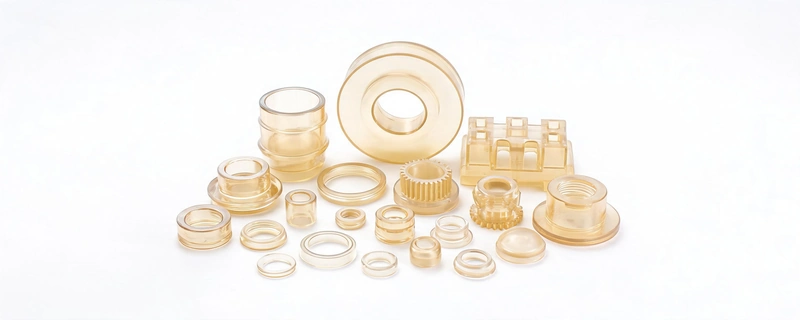
PPSU CNC machining is used to produce custom components that require a combination of toughness, dimensional performance and resistance to hot water and steam. PPSU, or polyphenylsulfone, is an amorphous high-performance thermoplastic. It can be machined into prototypes, functional parts and low-volume production components when the required geometry is difficult or uneconomical to mold.
However, successful PPSU machining is not simply a matter of choosing a suitable cutting tool. Residual stress in the stock material, part geometry, clamping pressure, heat generation and machining sequence can all influence the final result.
1. Why Use CNC Machining for PPSU Parts?
PPSU is selected for applications where ordinary plastics may not provide the required combination of impact resistance, toughness and hot-water performance. CNC machining allows engineers to produce custom shapes directly from PPSU sheet, rod or other suitable stock forms.
Common reasons to choose CNC machining include:
- Complex geometries: Internal channels, pockets, holes, slots and custom interfaces can be produced without dedicated injection molds.
- Prototype development: Machined components can support design verification before investment in production tooling.
- Low-volume production: CNC machining may be more economical than molding when quantities are limited.
- Custom dimensions: Components can be manufactured to drawing requirements using appropriate machining and inspection processes.
- Material flexibility: Different PPSU stock forms and grades can be evaluated for specific application requirements.
For high-volume production of repeatable geometries, injection molding may offer better unit economics. The decision depends on production quantity, part complexity, tooling cost and the required material grade.
2. Typical PPSU CNC Machined Components
PPSU can be machined into a variety of industrial and technical components. The suitability of a specific part depends on the grade, design, operating environment and applicable qualification requirements.
- Fluid handling components: Custom manifolds, connectors, valve components and fluid-contact parts.
- Medical equipment components: Selected instrument housings, holders and equipment parts, subject to grade selection and finished-device validation.
- Laboratory equipment: Custom fixtures, holders and components exposed to demanding cleaning conditions.
- Industrial equipment: Insulating components, protective covers and custom mechanical parts.
- Prototype components: Functional samples for fit, assembly and performance evaluation.
3. Critical Factors in PPSU CNC Machining
Tool Sharpness and Cutting Geometry
Sharp cutting edges help reduce friction, heat generation and unwanted surface damage. Dull tools can rub instead of cutting cleanly, increasing local temperature and potentially affecting surface quality.
Tool material and geometry should be selected according to the PPSU grade, part geometry, machining volume and required finish. Suitable carbide tooling is a common starting point, but the final choice should be established through machining trials and tool-life evaluation.
Heat Management
Although PPSU is an engineering thermoplastic, excessive heat during machining can affect dimensional stability and surface quality. Heat may accumulate around deep pockets, small holes and thin sections, especially when chips are not removed efficiently.
- Use cutting conditions appropriate to the tool and material grade.
- Maintain effective chip evacuation.
- Avoid prolonged rubbing or unnecessary tool dwell.
- Use coolant or air assistance only after checking material and process compatibility.
- Allow parts to return to a stable temperature before precision inspection.
Residual Stress and Annealing
Residual stress may already exist in extruded, molded or otherwise processed PPSU stock. Machining removes material and changes the balance of stress within the workpiece. This can lead to distortion, dimensional movement or stress-related cracking in demanding parts.
For complex geometries, deep material removal or tight dimensional requirements, a staged machining strategy may be appropriate. Depending on the stock grade and supplier recommendations, stress-relief annealing may also be considered before or during the machining sequence.
Annealing temperature, duration and cooling procedure should not be selected from a universal rule. They need to follow the material manufacturer's technical guidance and account for the original stock condition, section thickness and part design.
Clamping and Workholding
Excessive clamping force can deform plastic stock during machining. A part may appear dimensionally correct while clamped but move after release. This is particularly important for thin walls, large flat surfaces and components with uneven material removal.
Use stable workholding with distributed support. Avoid concentrated clamping pressure, and consider soft jaws, fixtures or additional support for delicate geometries.
4. PPSU Machining: Common Problems and Solutions
| Potential problem | Possible cause | Practical approach |
|---|---|---|
| Dimensional movement after machining | Residual stress, uneven material removal or temperature variation | Consider staged machining, suitable stress relief and temperature stabilization before inspection. |
| Rough or melted-looking surface | Excessive heat, dull tools or poor chip evacuation | Review tool sharpness, cutting conditions and chip removal. |
| Cracks near holes or corners | Stress concentration, machining damage or excessive clamping | Use suitable radii, controlled drilling procedures and improved workholding. |
| Thin-wall deformation | Insufficient support or excessive cutting forces | Use staged machining, suitable fixtures and balanced material removal. |
| Inconsistent dimensions | Temperature changes, stock variation or inconsistent inspection conditions | Stabilize the part and measurement environment, then inspect using a defined procedure. |
5. Design Guidelines for CNC Machined PPSU Parts
Good part design can reduce machining difficulty, improve repeatability and help control production cost. Engineers should consider the following points before releasing a PPSU component drawing.
Avoid Sharp Internal Corners
Sharp internal corners can create stress concentrations and are also difficult to machine with standard rotating tools. Where the design allows, use internal radii that match the selected cutter geometry.
Review Wall Thickness
Very thin walls may deform under cutting forces or clamping pressure. Where possible, use consistent wall thickness and avoid unnecessary deep pockets that leave unsupported sections.
Consider Hole and Thread Design
Hole depth, diameter, edge distance and thread engagement should be reviewed together. Deep small-diameter holes can create chip evacuation challenges. Thread dimensions and installation loads should be designed for the mechanical requirements of the finished component.
Specify Functional Tolerances
Not every feature needs the same tolerance. Applying unnecessarily tight tolerances to non-functional dimensions can increase machining time, inspection effort and material waste.
Identify critical mating surfaces, sealing features, alignment dimensions and assembly interfaces clearly on the drawing. Achievable tolerances should be confirmed based on geometry, stock quality, machining strategy and inspection method.
6. CNC Machining vs. Injection Molding for PPSU
CNC machining and injection molding serve different production needs. The right process depends on the component design, quantity, tooling investment and dimensional requirements.
| Consideration | CNC Machining | Injection Molding |
|---|---|---|
| Initial tooling | Usually lower dedicated tooling investment | Requires mold design and tooling |
| Prototype production | Well suited to design verification | Less convenient when mold investment is not justified |
| Production quantity | Often suitable for prototypes and low-to-medium volumes | Often more economical for repeat high-volume production |
| Design changes | Can often be implemented by updating machining programs | May require mold modification |
| Material utilization | Material is removed from stock, generating chips | Material is shaped in a mold, with process-dependent runners and waste |
For a small batch of custom manifolds or instrument components, CNC machining may be a practical option. For large quantities of identical parts, injection molding should also be evaluated.
7. Material Selection and PPSU Grade Considerations
PPSU is an amorphous high-performance thermoplastic known for its toughness and resistance to hot water and steam in appropriately selected grades. However, material performance is grade-dependent. Stock manufacturing method, additives, colorants and processing history can influence machining behavior and final properties.
Before machining, confirm the following information with the material supplier:
- Exact PPSU grade and manufacturer.
- Stock form, manufacturing process and available dimensions.
- Technical data sheet and relevant property information.
- Any applicable regulatory or application-specific documentation.
- Recommended machining and stress-relief guidance.
- Compatibility with the intended operating chemicals, temperatures and cleaning procedures.
For medical equipment, repeated steam sterilization or other regulated applications, verify the documentation for the exact grade and validate the finished component under its actual service conditions.
8. What Information Is Needed for a PPSU CNC Quote?
To evaluate a custom PPSU machining project, provide as much of the following information as possible:
- Technical drawing: PDF, STEP, STP or another suitable CAD format.
- Material specification: PPSU grade, manufacturer or required performance characteristics.
- Dimensions and tolerances: Identify critical dimensions and surface requirements.
- Order quantity: Prototype quantity, trial batch or estimated annual demand.
- Application: Operating temperature, media exposure, cleaning method and mechanical loading.
- Inspection requirements: Any dimensional reports, material documentation or other agreed quality records.
With this information, the machining process, material availability, manufacturing feasibility and inspection requirements can be reviewed before quotation.
Conclusion
PPSU CNC machining offers a practical way to manufacture custom engineering components without investing in dedicated injection molds. However, good results depend on more than machine accuracy. Material condition, residual stress, heat management, workholding, tool sharpness and drawing requirements all influence the finished part.
Teda Plastics supplies engineering plastic materials and supports custom CNC machined plastic components based on customer drawings. Contact our team to discuss your PPSU material and machining requirements.
Frequently Asked Questions About PPSU CNC Machining
1. Can PPSU be CNC machined?
Yes. PPSU can be machined using suitable CNC milling, turning, drilling and other conventional machining processes. Tool selection, workholding, heat management and the condition of the original stock are important for achieving consistent results.
2. Is PPSU difficult to machine?
PPSU can be machined successfully, but it requires attention to thermoplastic-specific factors such as heat generation, residual stress and deformation under clamping. Complex geometries and thin sections generally require more careful process planning.
3. Does PPSU need annealing before CNC machining?
Not every PPSU component requires annealing. Stress relief may be considered for complex parts, significant material removal or applications with demanding dimensional requirements. The procedure should follow the specific material supplier's recommendations.
4. What tools are suitable for PPSU machining?
Sharp cutting tools with suitable geometry are important. Carbide tools are a common starting point, but the best tool depends on material grade, machining operation, production volume and required surface finish.
5. Can PPSU CNC parts withstand autoclave sterilization?
Selected PPSU grades are used in components designed for repeated steam sterilization. Actual suitability depends on the grade, component design, sterilization cycle, chemicals and service conditions. The finished part must be validated for its intended use.
6. What tolerances can be achieved when machining PPSU?
Achievable tolerances depend on part geometry, stock condition, dimensions, wall thickness, machining strategy and inspection conditions. Critical tolerances should be reviewed against the drawing before production rather than assumed from a universal value.
7. Is CNC machining better than injection molding for PPSU?
Neither process is universally better. CNC machining is often practical for prototypes, custom designs and limited quantities. Injection molding may offer better unit economics for large, repeat production runs when the tooling investment is justified.
8. What files are needed for a PPSU CNC machining quotation?
A dimensioned PDF drawing or 3D CAD file such as STEP or STP is helpful. Please also provide the material grade, order quantity, critical tolerances, surface requirements and application details where available.
Need Custom PPSU CNC Machined Parts?
Send us your drawings and technical requirements. Our team can review your project and discuss suitable PPSU material options and machining solutions.
Request a Quote