PU rod (polyurethane rod) is an industrial round stock material used to manufacture rollers, wear pads, buffers, bushings and other components exposed to friction, impact or repeated mechanical loading. Depending on its formulation and hardness, polyurethane can combine elasticity, resilience, abrasion resistance and load-bearing capability.
However, polyurethane is a broad material family rather than one fixed engineering plastic. Cast polyurethane elastomers and thermoplastic polyurethane (TPU), for example, have different manufacturing routes and processing characteristics. Selecting the right rod requires more than simply specifying a diameter.
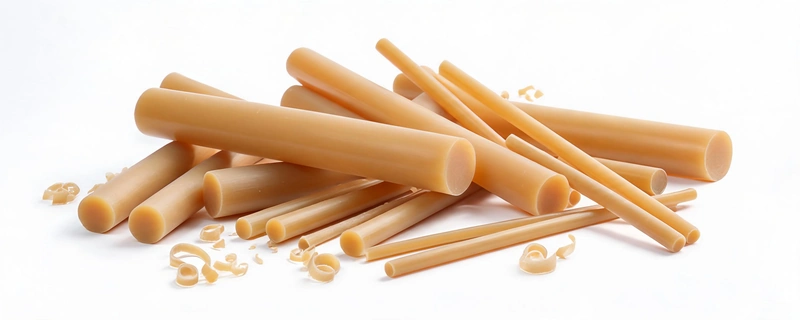
1. What Is PU Rod?
PU rod is a cylindrical semi-finished product manufactured from polyurethane. It is supplied for machining into custom industrial components or, depending on the product, for further processing.
Polyurethane materials can be formulated across a wide range of hardness levels. Softer grades behave like flexible elastomers, while harder grades provide greater resistance to deformation under load. This makes PU useful in applications where a balance between flexibility, impact absorption and wear resistance is required.
Industrial PU rods are commonly available in amber, translucent, yellowish or other colors. Appearance alone does not identify the exact chemistry, hardness or performance grade.
2. Key Properties of Polyurethane Rod
Elasticity and Impact Absorption
Many PU elastomer grades can deform under impact and recover their shape after the load is removed. This behavior makes them useful for buffers, impact pads, protective components and vibration-control parts.
Abrasion and Wear Resistance
Selected polyurethane grades offer good resistance to abrasion and repeated surface contact. They are often used in rollers, guide wheels, wear strips and material-handling components. Actual wear life depends on hardness, contact pressure, surface finish, speed and the presence of abrasive particles.
Tear and Mechanical Strength
Polyurethane elastomers can provide useful tear resistance and mechanical strength. These properties are important in components exposed to repeated deformation, edge loading or contact with moving parts. The performance of a specific grade should be checked against its technical data sheet.
Hardness Options
Hardness is one of the most important parameters when choosing PU rod. Softer materials may absorb impact and conform to a mating surface, while harder grades may provide better dimensional support under certain loads.
Chemical and Environmental Resistance
Resistance to oils, fuels, hydraulic fluids, solvents, cleaning agents and water varies with polyurethane chemistry. Some formulations are better suited to particular environments than others. Prolonged exposure can cause swelling, softening or changes in mechanical properties, so compatibility should be confirmed for the actual operating conditions.
3. Common Applications of PU Rod
Industrial Rollers and Wheels
PU rods can be machined into rollers, guide wheels and other rotating components. Depending on the grade and design, polyurethane can provide a useful combination of surface durability, resilience and grip.
Wear Pads and Sliding Components
Polyurethane is used in wear pads, guides, strips and contact components where repeated friction or impact occurs. The correct hardness and contact geometry are important for controlling deformation and wear.
Impact and Vibration-Control Parts
Buffers, bumpers, shock-absorbing elements and protective blocks can be manufactured from suitable PU grades. Their elastic behavior helps absorb energy during repeated contact.
Sealing and Fluid-Handling Components
Selected polyurethane grades are used for seals and other components in hydraulic and pneumatic equipment. Selection should consider pressure, movement, fluid compatibility, temperature and the required sealing geometry.
Custom Industrial Components
PU rod can be machined into spacers, sleeves, bushings, rollers and other custom shapes. For components with tight dimensional requirements, the material's elastic behavior must be considered during machining and inspection.
4. Cast PU Rod vs. Thermoplastic PU Rod
Not all polyurethane rods are produced in the same way. The manufacturing route affects the material structure, processing behavior and suitable applications.
| Consideration | Cast PU Elastomer | Thermoplastic PU (TPU) |
|---|---|---|
| Manufacturing route | Produced through a casting and curing process | Processed as a thermoplastic material |
| Material behavior | Commonly supplied as elastomeric stock | Thermoplastic elastomer behavior |
| Processing | Machining and casting-related processes, depending on product | Can be processed using suitable thermoplastic methods |
| Selection factors | Hardness, resilience, wear and load requirements | Grade-specific mechanical and processing requirements |
This is a general distinction, not a guarantee that every cast or TPU product has the same properties. Confirm the product type and technical specifications before ordering.
5. When Is PU Rod a Good Choice?
PU rod is worth considering when a component needs a combination of elasticity, impact absorption and abrasion resistance. It can be especially useful where a rigid engineering plastic would not provide the required flexibility or cushioning behavior.
It may be less suitable when the application requires very high continuous operating temperatures, high rigidity, very low friction or a specific chemical resistance that the selected polyurethane grade cannot provide.
For demanding temperature or chemical environments, engineers may also evaluate materials such as PTFE or PEEK. These materials have different mechanical behavior and should not be treated as direct replacements without checking the application requirements.
6. Temperature and Chemical Compatibility
There is no single temperature limit that applies to every PU rod. Continuous service temperature, short-term temperature resistance and mechanical performance at elevated temperatures depend on the polyurethane chemistry and formulation.
As temperature increases, some polyurethane grades may soften or lose mechanical performance. Low-temperature flexibility also varies by grade. Engineers should evaluate the actual operating temperature range rather than relying on a general temperature figure.
Chemical exposure requires similar care. Oils, fuels, hydraulic fluids, solvents and cleaning chemicals can affect different polyurethane formulations in different ways. If a component operates in contact with a fluid, confirm compatibility with the supplier before final material selection.
7. CNC Machining Considerations for PU Rod
Suitable polyurethane rods can be machined into custom components. However, machining elastomeric materials requires different considerations from machining rigid engineering plastics such as PEEK, POM or PPS.
Use Sharp Cutting Tools
Sharp tools help produce a cleaner cut and reduce unnecessary deformation. Tool geometry should be selected according to the material hardness, component shape and machining operation.
Control Clamping Pressure
Soft PU can deform under excessive chuck or fixture pressure. Workholding should support the material securely without compressing it beyond an acceptable level. Deformation during clamping can affect the dimensions measured during machining.
Manage Cutting Heat
Excessive heat can affect the surface quality and dimensional behavior of polyurethane. Cutting speed, feed rate, tool sharpness and chip removal should be adjusted for the specific grade and geometry.
Consider Elastic Recovery
Polyurethane can recover after machining forces are removed. A dimension measured while the material is compressed or under residual stress may differ from its relaxed dimension. Inspection procedures should account for this behavior.
Inspect the Finished Component
For precision parts, check dimensions after the component has been released from the fixture and allowed to stabilize. The achievable tolerance depends on hardness, geometry, stock quality, machining method and inspection conditions. A universal tolerance should not be assumed for all PU grades.
8. How to Select the Right PU Rod
Before selecting a polyurethane rod, define the operating conditions and component requirements. The following information helps narrow down the appropriate material:
- Hardness: Specify the required Shore A or Shore D value.
- Dimensions: Confirm rod diameter, length and machining allowance.
- Mechanical loading: Identify impact, compression, friction and repeated deformation.
- Operating temperature: Provide both normal and peak temperatures where relevant.
- Chemical exposure: Identify oils, hydraulic fluids, solvents or cleaning agents in contact with the part.
- Component design: Share drawings, tolerances and surface requirements for machined parts.
- Quantity: Specify prototype, small-batch or production requirements.
Providing these details makes it easier to assess whether a particular PU rod grade is suitable and whether the required dimensions can be supplied or machined.
9. PU Rod Supply from Teda Plastics
Teda Plastics supports industrial buyers looking for engineering plastic materials and custom components. For PU rod inquiries, we can review your required dimensions, hardness, application and machining requirements to help identify a suitable product specification.
For custom components, please send a technical drawing or sample information. Our team can review the requested geometry and discuss material selection, machining feasibility and quotation details.
Frequently Asked Questions About PU Rod
1. What is PU rod?
PU rod is a round stock shape made from polyurethane. Depending on its formulation and manufacturing process, it can provide elasticity, impact absorption, abrasion resistance and load-bearing performance for industrial components.
2. Is polyurethane rod the same as rubber rod?
No. Polyurethane is a distinct polymer family. Some PU grades behave like elastomers and can replace certain rubber materials, but their hardness, resilience, wear behavior, chemical resistance and temperature limits depend on the specific formulation.
3. What hardness is available for PU rod?
PU rod is available in different hardness ranges. Softer elastomer grades are commonly specified using Shore A, while harder grades may use Shore D. The required scale and value should be confirmed for the selected product.
4. Is PU rod suitable for high-wear applications?
Many polyurethane grades offer good abrasion and tear resistance, making them useful for rollers, wear pads, guides and impact components. Actual performance depends on hardness, loading, counterface, speed, temperature and operating environment.
5. What is the temperature limit of PU rod?
There is no single temperature limit for all polyurethane rods. Continuous service temperature and short-term temperature resistance vary with chemistry and formulation. Check the technical data for the exact grade and operating conditions.
6. Can PU rod be CNC machined?
Yes, suitable PU rods can be machined into custom rollers, bushings, seals and other components. Tool sharpness, workholding pressure, cutting heat, material hardness and elastic recovery must be considered.
7. How do I choose the right PU rod?
Specify the required hardness and scale, rod diameter, length, mechanical load, wear conditions, operating temperature, chemical exposure and component geometry. A drawing or sample can help confirm the appropriate grade and machining approach.
8. What information is needed for a PU rod quotation?
Provide the required diameter and length, hardness and scale if known, quantity, application and any chemical or temperature requirements. For machined components, include a drawing with dimensions and tolerances.
Looking for PU Rod or Custom Polyurethane Parts?
Send us your required dimensions, hardness specification or technical drawing. Teda Plastics can help review your material requirements and quotation request.
Contact Teda Plastics