PEEK (Polyetheretherketone) granules are high-performance thermoplastic pellets used to manufacture components through injection molding and extrusion. They are suitable for demanding applications requiring a combination of mechanical performance, chemical resistance and high-temperature capability.
The choice between virgin, reinforced and modified PEEK grades depends on the final component's design, operating environment and processing requirements. For manufacturers, selecting the correct pellet grade is an important step toward achieving consistent production quality.
What Are PEEK Granules?
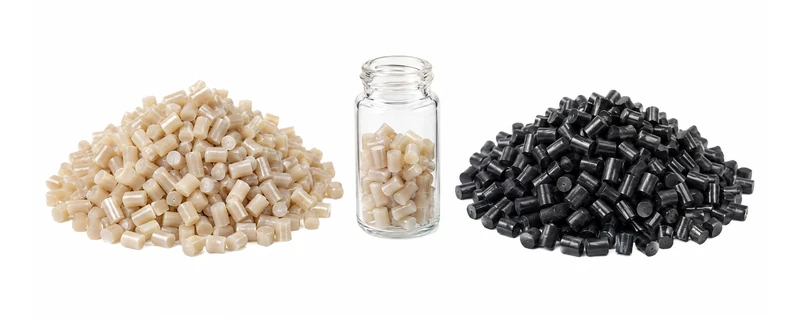
PEEK granules, also called PEEK pellets, are small solid particles used as feedstock for thermoplastic processing equipment. They are manufactured by processing PEEK resin into a pellet form suitable for controlled feeding, melting and shaping.
Virgin PEEK pellets contain no intentional fiber reinforcement or functional fillers. Reinforced and modified grades are formulated with additives such as carbon fiber, glass fiber, graphite or PTFE to adjust specific performance characteristics.
PEEK pellets are primarily used in injection molding and extrusion. Depending on the formulation and processing equipment, they can be converted into precision molded components, profiles, sheets, rods and other semi-finished products.
PEEK Granules Grades: Virgin, CF30, GF30 and Modified Grades
PEEK granules are available in different formulations. The most suitable grade depends on the required stiffness, wear behavior, dimensional stability, chemical exposure and electrical properties.
Virgin PEEK Granules
Virgin PEEK is an unreinforced grade. It offers a balanced combination of mechanical strength, toughness, chemical resistance and thermal performance.
It is commonly considered for precision molded components, electrical parts and applications where the addition of reinforcing fibers is not required. Natural virgin PEEK is usually supplied in a light brown or natural amber color, although appearance can vary by manufacturer.
CF30 PEEK Granules
CF30 PEEK typically contains approximately 30% carbon fiber reinforcement by weight. Compared with unfilled PEEK, it generally provides higher stiffness and lower thermal expansion in suitable material systems.
It is considered for structural components, precision parts and applications where rigidity and dimensional stability are important. Carbon fiber reinforcement can also increase electrical conductivity, so CF30 should not be selected for electrical insulation without checking the specific grade's electrical properties.
GF30 PEEK Granules
GF30 PEEK typically contains approximately 30% glass fiber reinforcement by weight. It generally offers increased stiffness compared with virgin PEEK and can be suitable for structural and dimensionally demanding applications.
Glass-fiber-reinforced PEEK is not automatically suitable for every electrical insulation application. The dielectric properties and other relevant characteristics should be verified using the grade-specific technical data.
Modified and Bearing-Grade PEEK
Modified PEEK formulations may contain combinations of carbon fiber, graphite, PTFE or other additives. These materials are developed to improve selected properties such as wear resistance, friction behavior or dimensional stability.
Bearing-grade formulations vary significantly between manufacturers. The exact filler content, friction behavior, wear performance and operating limits should be checked against the supplier's technical data sheet.
PEEK Pellet Properties and Technical Specifications
The table below provides indicative reference values for unfilled virgin PEEK. These are not guaranteed specifications for every commercial grade. Actual values depend on the resin formulation, processing conditions, specimen preparation and test method.
| Property | Typical Reference Value | Test Method |
|---|---|---|
| Density | Approximately 1.30 g/cm³ | ISO 1183 |
| Tensile Strength | Approximately 90–100 MPa | ISO 527 |
| Flexural Modulus | Approximately 3.5–4.1 GPa | ISO 178 |
| Melting Temperature (Tm) | Approximately 343°C | DSC |
For purchasing and engineering approval, always request the technical data sheet for the exact grade. A comparison should use the same test standards and comparable specimen conditions.
PEEK Injection Molding: Processing Conditions and Tips
PEEK is a high-temperature thermoplastic. Injection molding requires equipment capable of handling its high melt-processing temperatures, along with appropriate mold temperature control and process monitoring.
1. Material Drying and Moisture Control
Although PEEK has relatively low moisture absorption compared with many engineering plastics, pellets should still be handled and stored according to the material supplier's recommendations. Excess moisture or surface contamination can affect processing stability and finished-part quality.
Drying conditions should be based on the specific grade's technical data sheet. Do not apply one universal drying temperature or time to every PEEK formulation.
2. Melt Temperature
PEEK is commonly processed at melt temperatures in the approximate range of 360–400°C. The suitable temperature depends on the grade, melt viscosity, machine design, residence time and part geometry.
Excessive residence time or unsuitable processing temperatures can contribute to material degradation. Processing parameters should follow the grade supplier's recommendations and be validated on the actual equipment.
3. Mold Temperature and Crystallinity
Mold temperature plays an important role in PEEK crystallization and the resulting mechanical, thermal and dimensional properties. High mold temperatures are commonly used in PEEK injection molding, often in the approximate range of 170–200°C, depending on the grade and processing system.
Insufficient or inconsistent mold temperature control can lead to variations in crystallinity, shrinkage and component performance. The target conditions should be established according to the material manufacturer's processing guidance.
4. Injection Pressure and Filling
Injection pressure, injection speed, gate design and runner configuration all influence how the melt fills the mold. High-viscosity grades and thin-wall components may require particular attention to flow length, pressure loss and filling balance.
5. When to Choose CNC Machining Instead
Injection molding requires mold design, tooling investment and process validation. For prototypes, small quantities or frequently changing designs, machining PEEK sheet or rod may be more practical.
For more details, see our PEEK CNC machining guide.
PEEK Granules for Extrusion Applications
PEEK pellets can also be used in extrusion processes to manufacture semi-finished stock shapes and specialized profiles. Depending on the equipment and product design, extrusion can produce PEEK rods, sheets, tubes and other continuous profiles.
Extrusion requires careful control of melt temperature, screw speed, pressure and cooling conditions. These parameters influence melt stability, crystallinity, dimensional consistency and the quality of the finished profile.
For manufacturers producing PEEK stock shapes, consistent pellet quality and a stable processing window are important for maintaining reliable production.
PEEK Granules vs. PEEK Powder
PEEK granules and PEEK powder are both raw material forms, but they are intended for different processing methods.
- PEEK granules: Primarily used for injection molding and conventional extrusion processes.
- PEEK powder: Used in selected powder-based processes, coatings and specialized compounding applications.
- PEEK filament: Used in filament-fed FDM/FFF 3D printing systems.
- PEEK powder for SLS: Requires suitable particle characteristics and powder specifications for the selected additive manufacturing system.
Standard injection molding pellets are not automatically suitable for every powder-based or filament-based manufacturing process.
Learn more in our PEEK powder guide.
PEEK Granules vs. PEEK Rod and Sheet
PEEK granules are raw material feedstock for molding and extrusion. PEEK rods, sheets and tubes are semi-finished stock shapes that can be cut and machined into finished components.
The choice depends on the production method and required quantity:
- Granules: Suitable for injection molding and extrusion production.
- Rods and sheets: Suitable for CNC machining, prototypes and customized components.
- Tubes: Suitable for machined sleeves, bushings and other tubular components.
For low-volume customized parts, machining from stock shapes can avoid mold investment. For repeated production of suitable geometries, molding may offer better production economics.
How to Choose the Right PEEK Pellets
Selecting PEEK granules should start with the actual application rather than the material name alone. Consider the following factors before choosing a grade.
- Mechanical load: Determine whether the component needs toughness, stiffness, strength or wear resistance.
- Operating temperature: Evaluate continuous and intermittent temperatures under actual service conditions.
- Chemical exposure: Confirm resistance to the specific chemicals, concentrations and exposure times.
- Dimensional stability: Consider thermal expansion, shrinkage, fiber orientation and component geometry.
- Electrical requirements: Check volume resistivity, dielectric strength and other relevant electrical properties.
- Processing method: Confirm that the grade is suitable for the intended injection molding or extrusion equipment.
- Regulatory requirements: Request specific documentation for medical, food-contact or other regulated applications.
Virgin, CF30, GF30 and modified PEEK grades have different performance profiles. A grade should be selected only after the critical application requirements have been identified.
What Should You Check Before Buying PEEK Granules?
For industrial buyers, the consistency of the raw material is just as important as its headline mechanical properties. Before placing an order, discuss the following points with your supplier.
- Material grade: Confirm virgin, CF30, GF30 or the exact modified formulation.
- Filler content: Verify the type and percentage of carbon fiber, glass fiber or other additives.
- Melt flow or viscosity: Check whether the material's flow characteristics are suitable for your machine and mold design.
- Pellet consistency: Confirm pellet dimensions, appearance and feeding suitability.
- Technical Data Sheet: Request a grade-specific TDS with test methods and property values.
- Safety Data Sheet: Request the SDS for handling, storage and workplace safety.
- Batch traceability: Ask about batch identification and consistency between production lots.
- Packaging: Confirm bag size, moisture protection and export packaging requirements.
- Quality documentation: Confirm which inspection reports or certificates can be supplied for the selected grade.
Packaging, Storage and Material Handling
PEEK granules should be stored in sealed packaging in a clean, dry environment. Keep bags closed when the material is not in use to reduce the risk of moisture pickup and contamination.
Packaging formats and net weights vary by manufacturer and order requirements. Common industrial bag sizes may be available, but the actual packaging should be confirmed before ordering.
During production, use clean material-handling equipment and follow the supplier's recommendations for drying, conveying and storage. Avoid mixing different grades or batches unless the processing procedure has been properly evaluated.
Frequently Asked Questions About PEEK Granules
Looking for a Reliable PEEK Granules Supplier?
Teda Plastics Co., Ltd. supplies engineering plastic materials, including PEEK granules for injection molding and extrusion applications. We work with industrial buyers, distributors and manufacturers looking for suitable material grades and technical specifications.
Whether you need virgin PEEK, carbon-fiber-reinforced PEEK, glass-fiber-reinforced PEEK or a modified grade, please share your required specifications and application details with our team.
Grade availability, packaging, technical documentation and order conditions are subject to confirmation. We recommend reviewing the relevant TDS before material approval.
Request a Quote for PEEK Granules
Tell us your required grade, quantity and processing application. Contact our team to discuss specifications and quotations.
Request a Quote WhatsApp Us